Quick Facts About Chile
- Official name: Republic of Chile
- Independence date: September 18, 1810 – the beginning of the struggle for independence, though full independence wasn’t declared until 1818
- Capital: Santiago
- Currency: Chilean Peso
- Power Adapter: Type C or sometimes Type L
- Population: 20 million (2025 est.)
- Yearly tourist visits: 5.2 million (2024 est.)
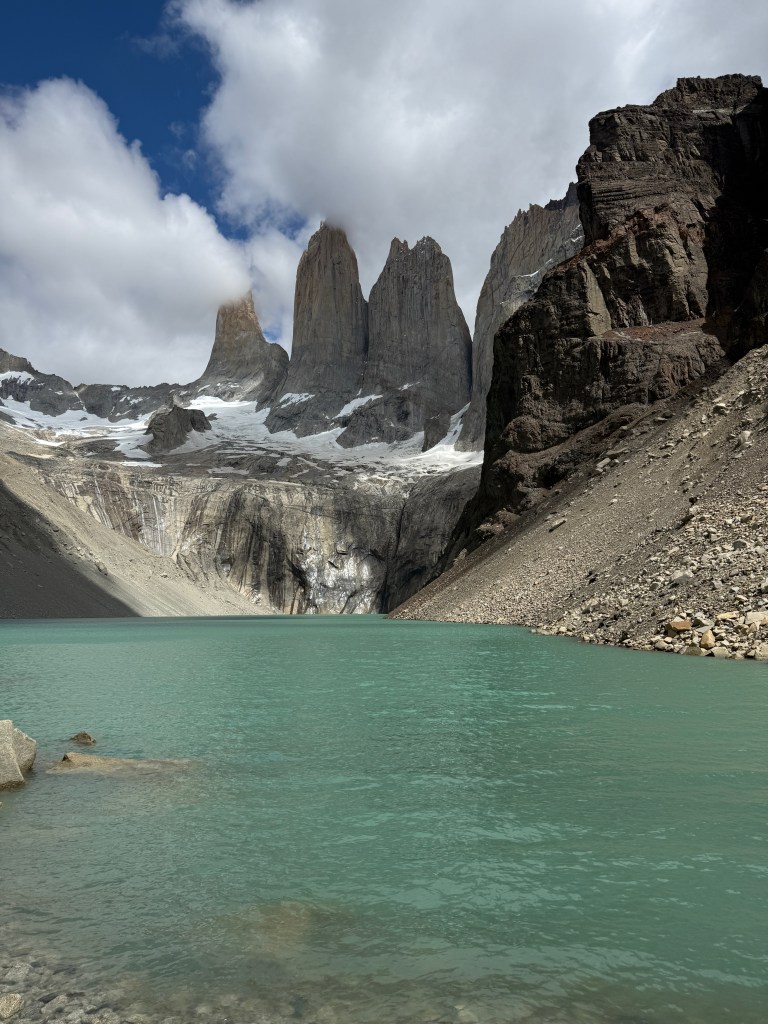
- Best known for: Extremely diverse landscapes (desert, Andes, glaciers, beaches, etc.), world class wines, poetry, food, adventure, and even mining as the world’s largest producer of copper
A very short history of Chile:
As with other countries of the Americas, Chilean history can easily be separated into three distinct eras: pre-Columbian, Spanish colonial, and independence/modern era. In the pre-Columbian era, native peoples were divided into several groups located throughout what is now Chile. Some of these groups were agricultural societies, but others, namely those centered around Patagonia, were more hunter-gatherers due to the grasslands and large guanaco populations.
In the late 15th Century the Incan Empire tried, but ultimately failed, to conquer northern Chile. In 1520, Ferdinand Magellan crossed the Strait of Magellan and was the first European to see Chilean territory. However, most historians credit Diego de Almagro with “discovering” Chile in 1537. In 1541, a Spanish force under Pedro de Valdivia established the city of Santiago, the modern day capital of Chile.
Though the Spanish did not find gold (the main impetus for their colonization of the Americas), they did recognize the agricultural richness of Chile and attempted to subjugate the entire region. However, the Spanish were never able to conquer the Mapuche who resisted their rule all the way until Chilean independence.
With the decline of the Spanish Empire, Chile’s independence movement coincided with the larger movement across South America (including in neighboring Argentina). That doesn’t necessarily mean that everyone supported it – indeed, Chileans were divided between independents and royalists. The dates of independence are also not clean, as some historians assert the beginning of the military junta in 1810, while others insist 1818 is the true date when there was a formal declaration independence.
When doing a brief overview of Chilean history, the most important moment of the independence movement came in 1817-1818 when Jose de Martin led an army through the Andes from Argentina and decisively defeated the Spanish (he would later continue his liberation in Peru). The early years of independence were turbulent, especially as the threat of a Spanish reconquest from Peru remained possible. However, the defining achievement of the early government was the elimination of slavery in 1823, earlier than most countries in the world.
In 1833 the Chilean Constitution was enshrined and was one of the most durable constitutions of South America, lasting until 1925. This period featured significant stabilization of the country, the establishment of the University of Santiago, and a territorial dispute with Argentina over Patagonia and the far south of the continent that was finally resolved in 1881. Chile also won a war against Bolivia and Peru, dramatically expanding Chilean territory to the north.
In the early 1920s, reforms sparked a series of military coups that led to a period of instability that lasted until 1932. Despite the instability – or maybe because of it – a new constitution was adopted in 1925. From 1932 until 1973 Chile returned to presidential rule and several advancements were made.
In 1970, Salvador Allende, a popular and outspoken Marxist, won the presidency and immediately implemented socialist policies. The US strongly opposed his rule with economic sanctions and covertly tried to destabilize his government, not only due to the spread of communism to South America but more to protect its own investments after Allende nationalized several US industrial interests.
By 1973 the Chilean economy was in shambles and the military decided to seize control once again with some support of the CIA. Allende, to avoid capture, committed suicide and General Augusto Pinochet installed himself at the head of a military junta. Pinochet’s dictatorship was defined by brutal state repression, torture, murder, and people being disappeared. By 1988, the junta finally started to relinquish power and agreed to an election, in which Pinochet was defeated and removed from power.
After 1990 Chilean politics have swung back and forth between left and right wing parties. Much of the focus has been to undo the damage caused by the dictatorship and bring Chile fully into the 21st Century with several political advancements.
We really enjoyed our visit to Chile and we know you will too! Check out our visit to Patagonia and Santiago,