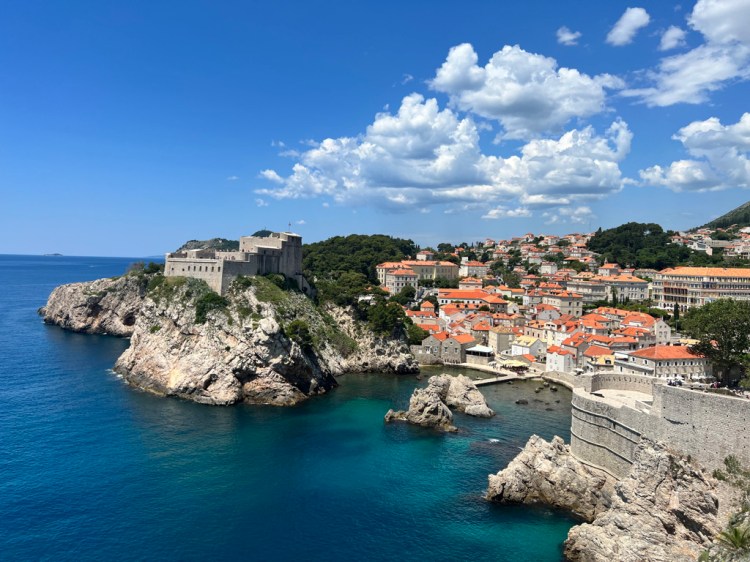
Quick Facts About Croatia
- Official name: Republic of Croatia
- Independence date: June 25, 1991
- Member of the EU?: Yes
- Capital: Zagreb
- Currency: Kuna
- Power Adapter: Type C or Type F
- Population: 4,000,000 (2023 est.)
- Yearly tourist visits: 16 million (2022 est.)
- Best known for: Beaches and sailing! Croatia has over 2,500 miles of coastline
A short history of Croatia
Boiling down Croatian history to only one paragraph is almost impossible, but here it goes. The modern Croatia was a part of the Roman Empire, split between the two provinces of Illyricum and Dalmatia. After the fall of the Roman Empire, Croatia was incorporated into the Byzantine Empire, where it remained until around 800 when it became the Duchy of Croatia, and eventually the Kingdom of Croatia in 925. From 1102 until 1527, the Kingdom of Croatia was alternatively aligned with Hungary, the Republic of Venice, and the Republic of Regusa.
Croatia then became a strong part of the Habsburg Monarchy until the break up of the Austro-Hungarian Empire following WWI, when Croatia was officially incorporated as part of Yugoslavia where it would stay until 1991. In 1991, Croatia and Slovenia declared independence from Yugoslavia, igniting a bloody war referred to today as the “Croatian Homeland War”. With the war’s end in 1995, Croatia has aligned more closely with Europe and has joined the EU and the Schengen Area.