Quick Facts About The Netherlands
- Official name: The Kingdom of the Netherlands (while Holland is sometimes used interchangeably, Holland actually refers to just 2 of the 12 provinces of the Netherlands)
- Independence date: July 26, 1581 – Declaration of independence from the Spanish. May 5, 1945 is more widely celebrated as Liberation Day, the day when the Netherlands was finally released from Nazi control
- Member of the EU?: Yes
- Capital: Amsterdam
- Currency: The Euro
- Power Adapter: Type C or Type F
- Population: 17.9 million (2023 est.)
- Yearly tourist visits: 20.3 million (2024 est.)
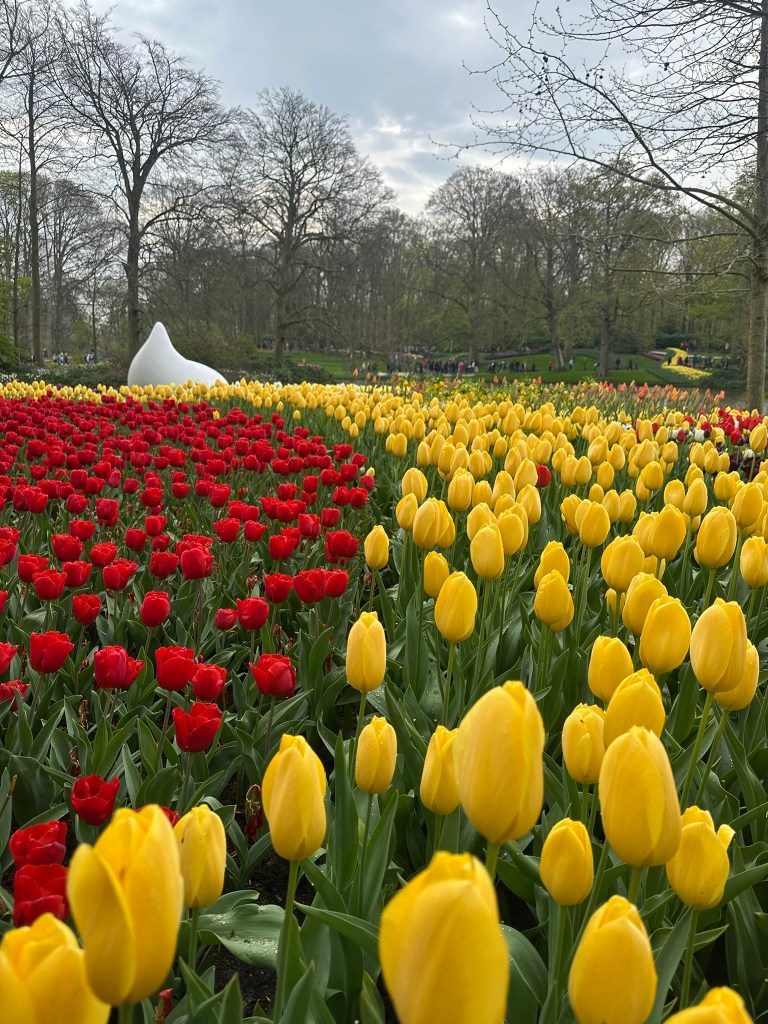
- Best known for: Iconic windmills, tulips, cheese, canals and water management, rich cultural history
A very short history of the Netherlands:
Like many other parts of Europe, the Netherlands was part of the Roman Empire at its peak. The Netherlands constituted an important frontier along the Rhine River, from which the Romans exerted influence even beyond their borders into modern day Germany. When the Roman Empire fell, many groups battled for control over the area, with the Frisian Kingdom centered around Utrecht eventually emerging in the 7th Century.
As the Frisian Kingdom waned in power, the area was the battleground for several empires and subject to a series of Viking raids over the next several centuries. For a couple centuries the area was under the control of the Holy Roman Empire, but they could not maintain control and the Netherlands split again into several smaller kingdoms. Many of the townships were nominally fiefs of either the French or the Holy Roman Empire in the ensuing period, though with the ascension of Charles V to the Hapsburg throne the Netherlands became administered by the Spanish.
The Dutch revolted in the 80 years war, eventually securing independence from the Spanish in the Treaty of Westphalia in 1648. Following independence, the Dutch built a massive empire, eventually dominating trade across several several continents in what came to be known as the Dutch Golden Age. Dutch power was at a peak at this point before starting to wane in the late 18th Century as the British rose to the top.
Napoleon conquered the area in 1796, maintaining control until 1815 with his defeat and abdication in the Congress of Vienna. At this moment William I declared him self King and raised the Netherlands to a kingdom. From 1815 to 1940 the Netherlands saw impressive population and economic growth, though the invasion by the Nazis in May 1940 wreaked havoc on the country.
For the next 5 years the Dutch suffered under a brutal occupation, only achieving liberation 2 days before the end of the war on May 5, 1945. The post-war period saw a focus on rebuilding the country and decolonization of the last remaining colonies, namely Indonesia. Economic rebirth led to increasingly progressive policies and a leading role in many international organizations, including the European Union.
Check out our 10 day trip to Belgium and The Netherlands to help you plan your next trip!