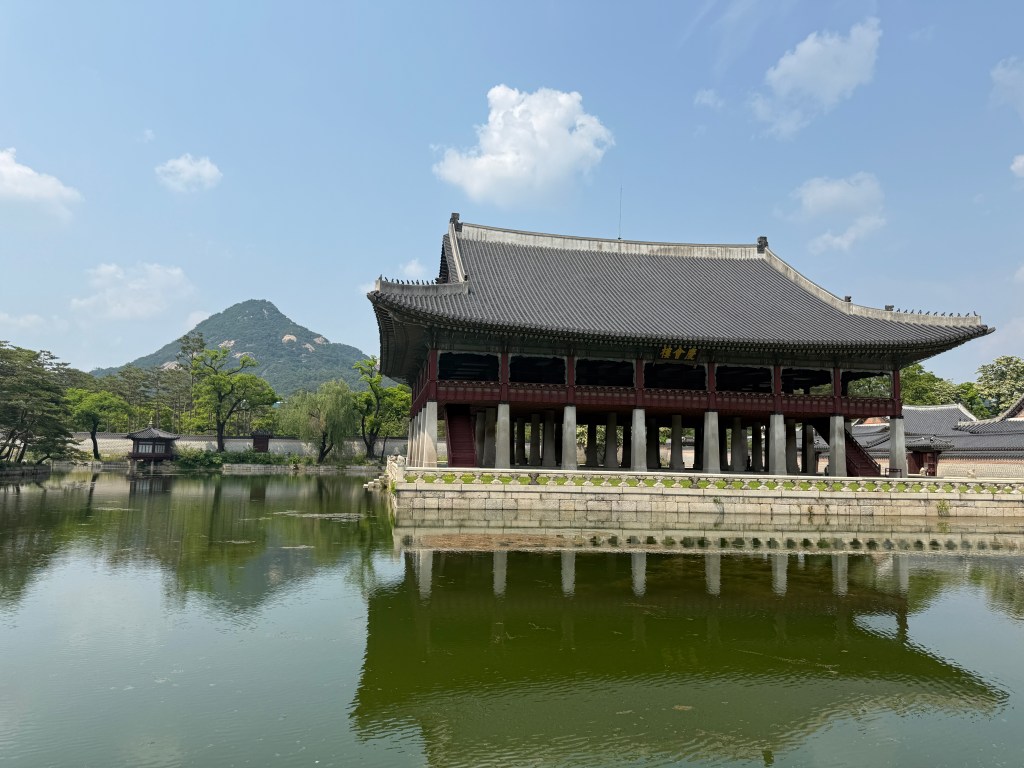
Quick Facts About South Korea
- Official name: The Republic of Korea
- Independence date: August 15, 1945 – Liberation Day. South Koreans celebrate the day that the country was liberated from Japanese colonial rule.
- Capital: Seoul
- Currency: South Korean Won
- Power Adapter: Type A or Type B. Type A is more common but any two-pronged plug from the US will be usable anywhere in Japan
- Population: 52 million (2024 est.)
- Yearly tourist visits: 16 million (2024 est.)
- Best known for: Culture, technological achievements, cuisine, K-pop, and so much more!
A very brief history of South Korea:
Korean legend states that the first kingdom on the Korean Peninsula was founded in 2333 BC, though it wasn’t until the 4th Century BC that the existence of a Korean Kingdom – the Gojoseon – was recorded in surviving Chinese texts. During this period the capital was Pyeongyang. After the fall of the Gojoseon, Korea was divided between three kingdoms in a period, known aptly, as the “Three Kingdoms of Korea.”
One of these kingdoms was the Goguryeo, founded in 37BC. Around 900AD a new successor dynasty was founded and became known as the Goryeo, which eventually morphed (thanks to non-native Korean speakers) into the name “Korea” of the modern state. It was during the Goryeo Kingdom that Buddhism flourished and a civil service system was established.
In 1231 the Mongols tried and failed to conquer the Korean Peninsula, though after 40 years of fighting Goryeo voluntarily submitted to Kublai Khan and became intertwined with the Yuan Dynasty until it’s collapse in the 1350s. After a coup in 1392, the Goryeo dynasty fell and was replaced by the Joseon. This dynasty would last for the next 500 years.
During this period, the Joseon successfully fought off invasions by both the Japanese (1592-1598) and the Manchu (1627-1638). Subsequently, Koreans began to discern themselves as a distinct group with a shared identity. Until the late 1800s the Joseon respected the traditional Chinese tributary system and deferred to their larger neighbors in many ways while maintaining an isolationist stance with much of the world. By 1882 the Joseon were essentially a client state of China.
That relationship was shattered as a result of the First Sino-Japanese War in which the Japanese defeated the Chinese. In 1897 Joseon was renamed the Korean Empire, and after the Japanese victory in the Russo-Japanese War in 1905 the Korean Empire effectively became a client state of the Japanese. However, the new state of affairs didn’t last long as the Empire of Japan annexed Korea in 1910.
For the next 35 years the Japanese brutally subjugated the Korean people until the Empire of Japan surrendered to the Allies in 1945. During this period the Japanese inflicted several atrocities on the local population, including the use of “Comfort Women.” These women were essentially sex slaves who endured horrific abuse by the Imperial Japanese soldiers during the occupation.
Just before the Japanese surrender, on August 14, 1945, the Soviets invaded northern Korea. The next day the Japanese unconditionally surrendered, but Soviet control of the north was achieved. The US duly occupied the southern half of Korea below the 38th Parallel, and the stage was set for the first showdown of the Cold War. While this division was only meant to be temporary before a full reunification of the entire Korean Peninsula, reunification is still a long off goal.
On June 25, 1950 the North Korean Army stormed across the 38th Parallel intending to push all US and South Korean forces into the sea before the US could fully mobilize. Only a daring amphibious landing rescued the situation, though as the US and UN forces drove towards the Korean-Chinese border, China officially entered the war with hundreds of thousands of soldiers storming across the Yalu River. Fighting eventually devolved into a stalemate centered very close to the 38th Parallel, and in 1953 a ceasefire ended hostilities with no real change in the border.
Following the war, the UN established the Demilitarized Zone (DMZ) to try to prevent renewed fighting. Despite some incursions and belligerence, the ceasefire has held. In the decades after 1953, South Korea began an incredible turnaround, modernizing and becoming a global economic power. North Korea, sadly, remains gripped by a Communist authoritarian government with people who continue to suffer greatly under the regime.
Check out our 16 day trip to Japan and South Korea for help planning your perfect vacation!