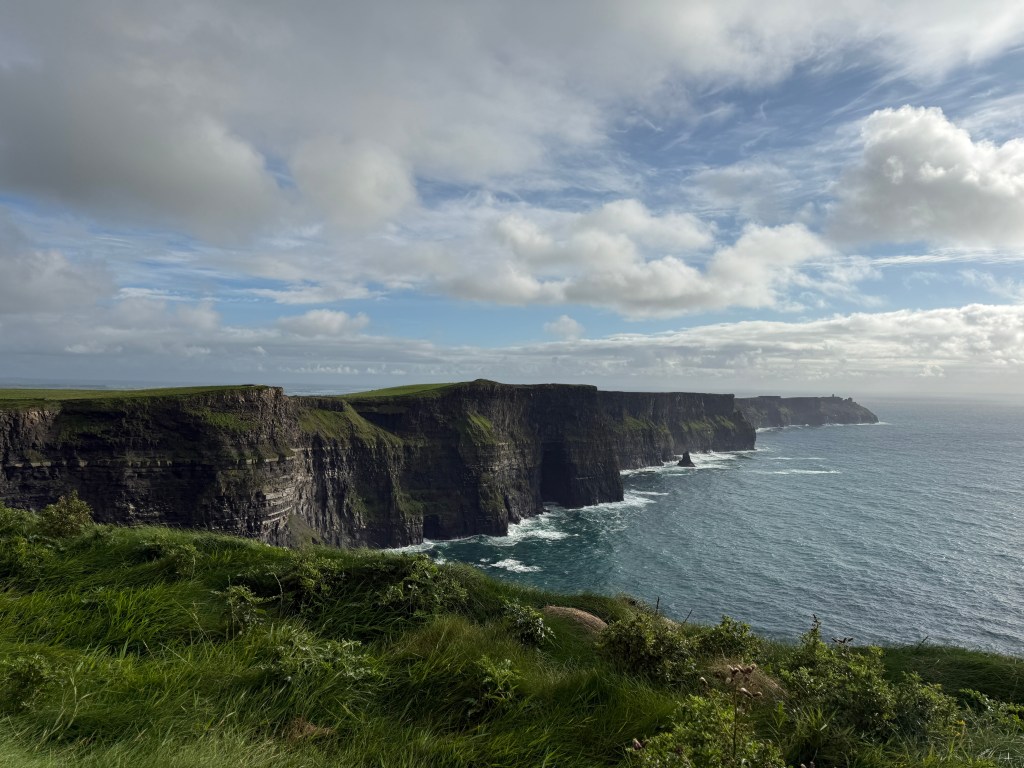
Quick Facts About Ireland
- Official name: Ireland
- Independence date: Ireland doesn’t celebrate a specific independence day, though April 24, 1916 is revered as the date proclamation of the Irish Republic. Ireland officially left the Commonwealth on April 18th, 1949. The most significant public holiday in Ireland is March 17th to commemorate the death of St. Patrick.
- Member of the EU?: Yes
- Capital: Dublin
- Currency: The Euro
- Power Adapter: Type C or Type F
- Population: 5.4 million (2024 estimate)
- Yearly tourist visits: 6.6 million (2024 estimate)
- Best known for: Incredible natural landscapes, friendly people, lush greenery, iconic landmarks, delicious food and drinks!
A very short history of Ireland:
In the few centuries before the Roman period, Ireland saw repeated invasions from various Celtic groups. These groups intermingled with the preexisting populations, eventually creating a distinct language and culture that permeates modern Ireland even today. While the Romans never directly invaded Ireland, their influence definitely extended to the island during the Empire’s height.
Perhaps the most important moment in Irish history is the arrival of St. Patrick in (legend states) 432 AD. While the myth of St Patrick may be greater than the reality, what is not in doubt is that during this period Irish laws were codified, the Roman alphabet was implemented, and Christianity flourished.
The period between 700 and 1100 was characterized by Viking invasions, with the biggest lasting impact being the establishment of Dublin as a major city and center of trade. Just after this period, in the late 1100s, the Normans arrived in Ireland and slowly began to conquer the island. King Henry II of England designated his younger brother John as King of Ireland, though when Henry unexpectedly died John assumed the crown of both England and Ireland for the first time.
For several centuries Ireland remained under the English crown, but centralized English power gradually waned and by the 1500s Ireland was essentially independent as England’s attention was focused elsewhere. In 1536, King Henry VIII decided to bring Ireland back under full English control, and Henry was proclaimed King of Ireland in 1542. The full reconquest of Ireland occurred under Elizabeth and James and by 1603 Ireland was brought fully under the Crown.
After the separation of the Church of England from Catholicism, the English Crown sought to make Ireland Protestant through a series of laws, settlements, and more. Through several centuries of these policies Ireland became continuously more Protestant rather than Catholic.
Following the Irish Rebellion of 1798, the English Parliament passed the Acts of Union which created the United Kingdom of Great Britain and Ireland (where the UK still gets its name to this day!). During this period Irish self-rule was effectively abolished and Ireland was ruled directly from the English thrown.
In the mid 1840s, the Great Potato Famine devastated Ireland, leading to mass starvation and a mass exodus of people from island. The effect was so severe that the population declined by more than 50% to 4.4 million by 1911. With the outbreak of World War I, the British Parliament passed the home rule act for Ireland, though its implementation was suspended until the end of hostilities.
The period of 1916-1921 was marked by political violence as the more hardline elements of the Irish faction refused any deals with Britain short of complete independence. This resulted in a low-level guerilla war, during which the island was split into Northern Ireland and Ireland, largely along religious lines with the Catholics dominating in the south and the Protestants in Northern Ireland. In 1921, Ireland was granted the status of Dominion in the Commonwealth, equal to that of Canada and Australia.
This arrangement lasted for the next 28 years, including during World War II when Ireland fought on the side of the Allies. However, in 1949 Ireland officially left the Commonwealth and became an independent state, while Northern Ireland remained part of the UK. With its ascension to the EU, Ireland initiated a period of stunning economic growth, though this was shattered during the 2008 Financial Crisis. Since that point Ireland has staged an economic rebound and is increasingly important in European politics.
Check out our 12 day trip to Ireland and Scotland to help you plan your next trip!
