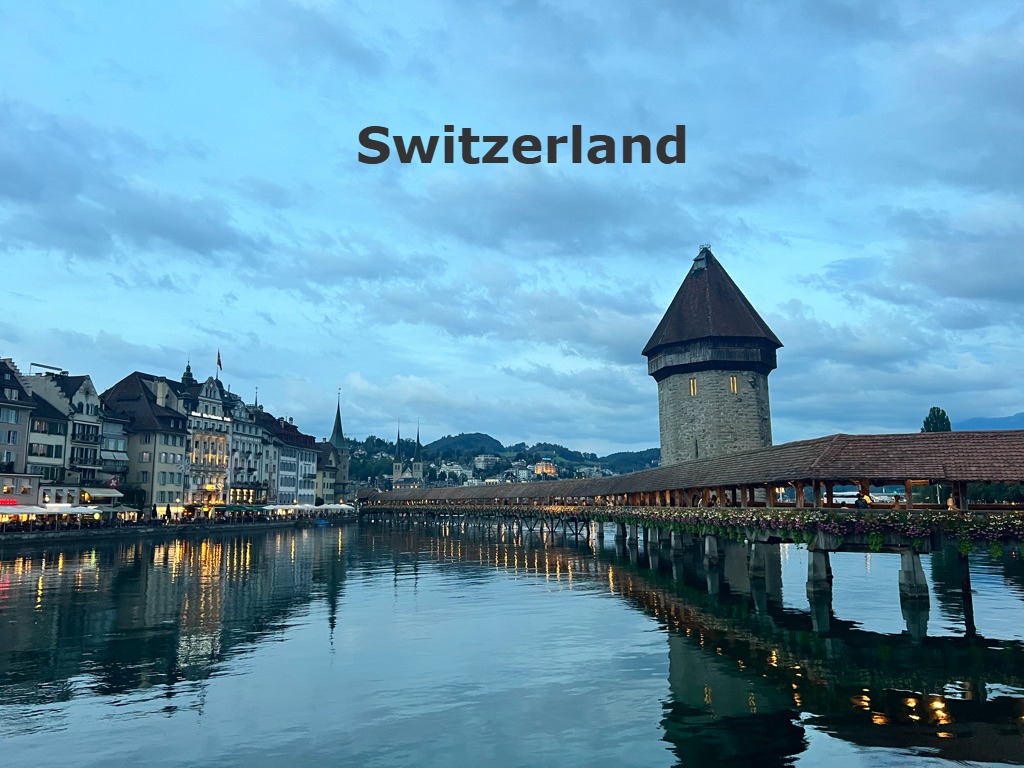
Quick Facts About Switzerland
- Official name: Swiss Confederation
- Independence date: August 1, 1291 – the founding of the Swiss Confederation when cantons came together to resist Hapsburg influence
- Member of the EU?: No (member of Schengen Area allowing freedom of travel across Swiss borders)
- Capital: Bern
- Currency: The Swiss Franc
- Power Adapter: Type J (Type C and F do not work)
- Population: 9,000,000 (2024 est.)
- Yearly tourist visits: 21 million (2023 est.)
- Best known for: Mountains, charming towns, unbelievable scenery
A very short history of Switzerland:
Like much of Europe, Switzerland was heavily influenced by Roman culture as the Romans established towns and spread Christianity throughout the region. With the fall of the Western Roman Empire in the 5th Century, the region spent several centuries in disarray, with competing kingdoms controlling different parts of modern-day Switzerland. The process of becoming Switzerland officially began in 1291, when 3 cantons (Uri, Schwyz, and Unterwalden) formed the Old Swiss Confederacy to maintain peace and stability following the death of a Hapsburg Emperor.
Over the next few centuries the Old Swiss Confederacy expanded to include more cantons, including Lucerne, Zurich, and Bern, and eventually grew powerful enough to defeat the Hapsburgs at the Battle of Sempach in 1386 to gain increased autonomy in the Holy Roman Empire. With additional military victories, including a key victory over Charles the Bold of Burgundy in the 15th Century, the Old Swiss Confederacy continued to grow in power and influence. That prestige was only further enhanced thanks to Swiss mercenaries, professional soldiers who served foreign powers (most notably the Kings of France) at a time when professional armies were abnormal. In 1506 the Vatican employed the Swiss Guard, which continues to serve the Pope in the present day.
In subsequent European wars, Switzerland was so vitally important thanks to Swiss mercenaries that no king was willing to let the area fall into enemy hands. Following the Treaty of Westphalia in 1648, Switzerland was officially granted independence from the Holy Roman Empire which lasted until Napoleon invaded and set up a temporary republic subservient to France. Following the end of the Napoleonic wars and the Treaty of Vienna in 1815, permanent Swiss neutrality was recognized by all European powers.
Thanks to military deterrence and logistical problems, Switzerland was never invaded by any military power in either of the World Wars. Though Germany did consider an invasion at the onset of World War II, Switzerland’s geography and determined population convinced the Nazi’s that it was futile. Switzerland’s importance during the war, however, cannot be understated as it was a vital hotbed of espionage and refuge for individuals fleeing the Axis powers. Following peace, Switzerland increased it’s ties with the rest of Europe, though has not formally joined the European Union. Despite Switzerland’s leading role in many international affairs, it did not join the United Nations until 2002. Today, Switzerland is a major tourism destination and should definitely be near the top of your list for places to travel!
Check out our 11 day trip through Switzerland for help planning your next trip!